
AI Music generators : Complete comparison guide 2026
- Stéphane Guy

- May 27
- 11 min read
Updated: May 28

Artificial intelligence is reshaping music creation and making composition accessible to everyone. Platforms like Suno AI, Udio, and AIVA now generate studio-quality tracks in minutes, with zero musical training required. But with the market flooded by competing tools, how do you pick the one that actually fits your workflow? This comprehensive guide benchmarks the top AI music generators available in 2026 to help you make the right call.
In short
AI music generators use deep learning to compose original tracks from text prompts or musical parameters.
Suno AI and Udio lead the market for vocal song generation, combining realistic voice output with an intuitive interface.
AIVA dominates orchestral and classical music : the go-to choice for cinematic soundtracks and professional productions.
Pricing ranges from free (with limits) to $250+/month for heavy professional use.
Copyright ownership is the critical variable: some tools transfer full rights to you, others retain them depending on your subscription tier.
Each platform has a niche: rapid creation, deep customization, genre-specific output, or broadcast-grade audio quality.
What is an AI music generator?
How musical artificial intelligence works
An AI music generator is software that uses artificial intelligence algorithms to create original musical compositions. These tools rely on deep learning technologies trained on millions of hours of existing music.
In concrete terms, you provide a textual description of the type of music you want (for example: "a melancholic pop ballad with piano and guitar"), and the AI generates a complete piece corresponding to your request. Some tools also allow you to add lyrics, choose a vocal style, or even customize the instrumental arrangement.
In short, musical AI works in much the same way as ChatGPT or DeepSeek, but for audio generation rather than text generation.
What are the different types of AI music generators?
Artificial intelligence systems to choose according to your needs and desires
Tools for the general public, such as Suno AI and Udio, offer a simplified approach: you describe what you want, and the AI takes care of the rest. These platforms excel at creating complete songs with vocals and lyrics.
Tools for professionals such as Aiva or Soundful offer improved control over the composition or use of music.
Specialized tools such as Mubert focus on specific niches: background music, real-time generative loops, or specific musical styles.
The 8 best AI music generators in 2026
Suno AI: one of the leaders in AI music generation

What is Suno AI?
Suno AI has established itself as the benchmark for creating songs with vocals. Launched in 2023, this tool can generate complete tracks with surprisingly realistic vocal performances in virtually every musical genre imaginable.
The strengths of Suno AI
Suno's strength lies in its ease of use: simply write a description in natural language, and the AI generates two different versions in less than two minutes. You can then refine the result, extend the piece, or create variations.
Suno AI pricing
The free version allows you to generate a limited number of tracks, and the tracks created cannot be used for commercial purposes. With the pro subscription at $10 per month, you have the right to use your music for commercial purposes. There is also a Premier subscription for $30 per month, which allows you to fully customize the music you create. To learn more about this AI and its pricing, we explain what Suno AI is here.
Udio AI: Suno's serious competitor

What is Udio AI?
Udio AI was developed by former Google DeepMind researchers and is positioned as an alternative to Suno. The platform stands out for its audio quality and its ability to generate complex instrumental arrangements.
The strengths of Udio AI
Udio excels particularly in vocal clarity and instrumental separation, producing tracks that can sound truly professional. The tool also supports generation in multiple languages, making it a versatile choice for international creators.
What sets Udio apart is its level of control: you can specify precise music tags (genre, instruments, mood, structure), extend your creations section by section, or even remix any part of the track.
Udio AI pricing
Udio offers three pricing plans: free, standard at $12 per month, and Pro at $36 per month. The more expensive the subscription, the more music you can create without restrictions. You also have the option to purchase credits to generate new music without changing your subscription.
AIVA: the specialist in classical and orchestral music

What is AIVA?
AIVA (Artificial Intelligence Virtual Artist) has a unique historical distinction: it is the first AI officially recognized as a composer by SACEM (Society of Authors, Composers, and Music Publishers) in France. This recognition enabled it to obtain the status of music publisher in 2016.
The strengths of AIVA
AIVA has been trained on over 20,000 classical music scores, including works by Bach, Mozart, Beethoven, and Vivaldi. This specialization makes it the tool of choice for composing orchestral, symphonic, and film music.
Arnaud Decker, marketing director at Aiva, explains: "We have an algorithm that we've fed with classical music—Bach, Beethoven, Mozart. Based on these 20,000 scores, AIVA will form an idea of what music is and create a mathematical model of this style. Then we ask it to write original pieces."*
Music AI tailored for professional use cases
AIVA is particularly well-suited to professional projects: film scores, video games, commercials, or audiovisual productions requiring high-quality orchestral compositions.
Aiva's rates
In addition to the free basic option, AIVA offers two other subscription plans: a standard plan for $15 per month and a professional plan for $49 per month. The main difference is that the latter subscription, which is also the most expensive, allows you to fully monetize your music, which is copyrighted to you. If you are a student, school, or business, AIVA also offers customized rates (by contacting them directly).
Soundraw: customization at your fingertips

What is Soundraw?
Soundraw takes a hybrid approach between automatic generation and manual editing. The interface features sliders and buttons that allow you to select the mood, genre, instruments, and tempo before instantly generating several variations of a track. Soundraw focuses exclusively on instrumental music, which sets it apart from Suno and Udio. This specialization makes it an excellent choice for video content creators, podcasters, or filmmakers looking for professional background music.
The strengths of Soundraw
The real strength of Soundraw lies in its editor: after generation, you can go into detail to customize the structure of the track, extend certain sections, shorten others, or reposition key moments.
Soundraw pricing
The license terms are particularly clear: all generated tracks are royalty-free. However, monetization and the format in which you can download your music will vary depending on the different subscriptions offered by the platform. There are four subscriptions available, with the most expensive costing $64.99 per month. While the platform specifies that commercial use is possible for all your creations, it also specifies that you cannot sell your music on mainstream audio platforms.
Mubert: real-time generative music
What is Mubert?
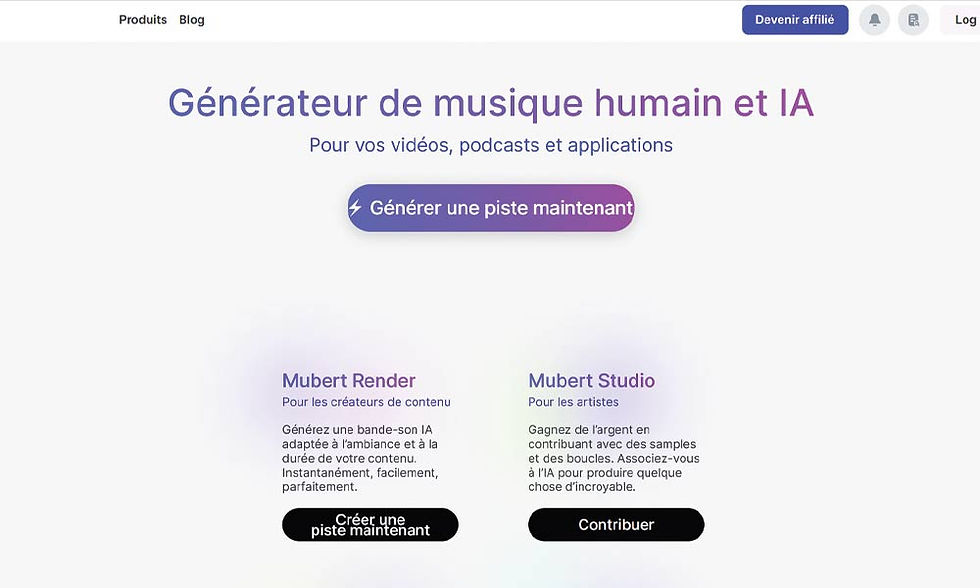
Mubert offers a radically different approach: rather than creating fixed pieces, the tool generates music continuously, in real time, adapting to the exact duration you need.
Mubert's strengths
This system is particularly well suited for streamers, creators of long-form videos, or continuous background music for commercial spaces or events.
Mubert's rates
Mubert offers several plans tailored to different profiles. An interesting point here is that the tool offers monthly subscriptions or perpetual licenses. There are three subscription plans: Creator at $14, Pro at $39, and Enterprise at $199. Perpetual licenses can cost up to $499. The latter allows you to allocate sub-licenses to other people and do pretty much whatever you want with your music: TV or radio advertising, monetized or boosted posts, etc.
Boomy: create and publish in just a few clicks

What is Boomy?
Boomy is an artificial intelligence that focuses on the extreme simplicity of music generation: in less than 30 seconds, anyone can generate a complete original song. The tool is particularly aimed at beginners and people with no musical experience.
Boomy's strengths
What makes Boomy unique is that the platform includes a direct distribution system to streaming platforms such as Spotify, Apple Music, and Deezer. This allows you to publish your creations and potentially generate revenue through streams.
Boomy's rates
Boomy offers roughly the same pricing as other AI services: free, creator at $14.99 per month, and pro at $39.99 per month. Here too, the higher the subscription price, the more ways you can use your music.
Soundful: royalty-free music for creators

What is Soundful?
Soundful is a platform that caters to all profiles: creators, professionals, individuals, and even brands. The wide variety of subscriptions and different options make the platform a credible solution for individuals and professionals alike who want music AI with the right pricing options.
The strengths of Soundful
Soundful emphasizes that each composition generated is unique and that the platform can help you create music for all uses and situations: podcasts, applications, events, etc.
Soundul's rates
The platform offers a free plan limited to one download per month for personal use, and can cost up to $249.99 per month. With the free plan, the platform offers no fewer than six different subscription options.
Deevid.Ai: A Music Generator and More

What is Deevid.Ai?
Deevid.Ai is a music generator that offers a wide range of options for creating music from scratch: with or without lyrics, music styles, descriptions, and more.
You can also import audio files to use as a base or inspiration. The AI will also let you regenerate previous results. In other words: replay the sound you’ve already produced to try to get a better version.
The strengths of Deevid.AI
Where the AI really stands out is in its versatility. In addition to music generation, Deevid also offers image, video, voice, and AI avatar generation. It’s therefore an all-in-one solution that lets you avoid spreading your subscriptions thin if you choose to purchase additional credits.
Deevid.AI's rates
Deevid offers three plans, available on an annual or monthly basis: Lite, Pro, and Premium. The Lite plan at $14 per month gives you 200 credits per month (it takes about 4 credits to generate a piece of music) along with basic features. The Pro plan, at $35 per month, includes 1080p video generation and 600 credits per month. The Premium plan, at $159 per month, offers 3,000 credits and advanced features such as priority support and a fast generation mode.
The complete comparison table of music-generating AIs
Critère | Suno AI | Udio AI | AIVA | Soundraw | Mubert | Boomy | Soundful | Deevid |
Speciality | Vocal songs | High fidelity audio | Classical music | Customization | Real time | Speed | All-in-one application | |
Easy to use | ⭐⭐⭐⭐⭐ | ⭐⭐⭐⭐ | ⭐⭐⭐ | ⭐⭐⭐⭐ | ⭐⭐⭐⭐ | ⭐⭐⭐⭐⭐ | ⭐⭐⭐⭐ | ⭐⭐⭐⭐ |
Audio quality | ⭐⭐⭐⭐ | ⭐⭐⭐⭐⭐ | ⭐⭐⭐⭐⭐ | ⭐⭐⭐⭐ | ⭐⭐⭐ | ⭐⭐⭐ | ⭐⭐⭐⭐ | ⭐⭐⭐ |
Personnalisation | ⭐⭐⭐⭐⭐ | ⭐⭐⭐⭐⭐ | ⭐⭐⭐⭐⭐ | ⭐⭐⭐⭐⭐ | ⭐⭐⭐ | ⭐⭐ | ⭐⭐⭐ | ⭐⭐⭐ |
Chorus generation | Yes | Yes | No | No | No | Yes | No | Yes |
Lowest price | 8$/month | 9,60€/month | 11€/month | 11,04€/month | 11,69€/month | 9,99€/month | 5$/month | 14$/month |
Highest price | 24€/month | 28,80€/month | 33€/month | 32,50€/month | 149,29€/month | 29,99€/month | 249,99$/year | 159$/month |
Commercial use | All except free | To be verified | Complete with Pro subscription | All types of subscriptions (subject to conditions) | Pro subscription for $32.49/month | Pro subscription for $29.99/month | License for $5/month | All paid subscriptions |
Best suited for | Pop/rock songs & beginners | High-quality music | Movies/games | Videos/podcasts | Streaming live | Beginners | YouTube/creators | Podcasts and music creation |
How to choose the right AI music generator for your project?
Depending on your level of musical experience
Complete beginners should start with Suno AI, Udio AI, or Boomy. These tools require zero technical knowledge and deliver impressive results in a few clicks.
If you have some musical grounding and want more creative control, Soundraw or Udio strike the best balance between simplicity and depth.
Professional composers or audiovisual producers should look at AIVA for the level of customization and quality demanded by high-end projects. For AI-generated lyrics and vocals, both Udio AI and Suno AI are strong options.
By Music Type
For songs with lyrics and vocals: Suno AI and Udio AI are the clear frontrunners. Their vocal generation capabilities are genuinely remarkable.
For orchestral or classical music: AIVA is the undisputed reference, with deep structural understanding of symphonic composition.
For background music (video, podcasts): Soundraw, Mubert, or Soundful offer clean solutions with transparent licensing.
For electronic or experimental music: Udio and Mubert open up original sonic territory. Suno also deserves mention for its ability to blend multiple styles without constraint.
By Budget and Commercial Needs
Budget decisions can't be separated from rights questions.
A free tier like Suno's base plan bars commercial use is a real problem if you're monetizing content.
For occasional commercial use, mid-tier plans often suffice, but most platforms will still require you to publish under their platform license.
For intensive professional use, the highest-tier plans generally provide near-total freedom for publishing, monetization, and commercial exploitation of your output.
The Current Limits of AI Music
Quality and Artistic Authenticity
Despite remarkable progress, AI music still has blind spots. Compositions can lack the emotional nuance and deliberate artistic intent that human creators bring. "Violinist Cho-Liang Lin remarks that AI music [is] spiritually vacant".*
Legal and Ethical Questions
Copyright ownership remains murky. Who actually owns an AI-generated track, the user who wrote the prompt? The company that built the model? The AI itself?
Before incorporating AI music into any commercial project, read the terms of service carefully.
Can AI Replace Musicians?
Short answer: no. At least not fully. AI music is a powerful tool for rapid creation, prototyping, and experimentation. It democratizes access to composition.
But for projects requiring sharp artistic direction, distinctive originality, or genuine emotional depth, human creativity remains irreplaceable. The strongest results emerge from combining AI's efficiency with human creative judgment.
AI Music Trends and Developments for 2026
Vocals That Sound Human
AI-generated voices are becoming increasingly indistinguishable from human voices. According to a report by the Reuters Institute, 19% of podcasts published in 2025 will contain segments generated or enhanced by AI.*
This trend creates new possibilities for creators while raising legitimate questions about transparency and authenticity in audio content.
Native Integration into Professional DAWs
More and more DAWs (Digital Audio Workstations) are embedding AI features directly into their interface. Ableton, for instance, is developing AI-powered plugins to streamline music production workflows.
This integration enables a hybrid approach: musicians can layer traditional composition with algorithm-generated suggestions, blurring the line between human and machine creativity.
Hyper-Personalized and Adaptive Music
The next wave promises even finer-grained control: adjusting emotional tone on demand, syncing generation in real time to video, or producing adaptive soundtracks that evolve with context, as already seen in next-generation gaming.
Practical Tips for Getting Started with an AI Music Generator
Master the Art of the Music Prompt
Output quality is directly proportional to prompt quality. The more specific your description, the better the result.
Don't write "a sad song." Write: "a melancholic acoustic piano ballad with soft female vocals, 60 BPM, slow tempo, in the style of..."
Include the key variables: genre, main instruments, tempo, emotional tone, stylistic references, and desired structure.
Iterate and Refine Across Multiple Generations
Never settle for the first output. Most tools let you regenerate, adjust, or extend tracks. Test multiple variations before committing to one direction.
Mix outputs across tools: create an intro with one generator, a chorus with another, then stitch everything together in a DAW like Logic Pro, FL Studio, or Ableton.
Know the Legal Boundaries
Always check the terms of service before using generated music commercially. Some platforms retain rights over your output even on paid plans.
For professional projects, prioritize platforms that explicitly assign you full copyright ownership.
Disclose AI usage where required: YouTube, Spotify, and other platforms are starting to mandate transparency around AI-generated content.
FAQ
Are AI music generators really free?
Most offer limited free tiers, restricted quotas, no commercial rights, reduced quality. For professional or high-volume use, a paid plan is almost always necessary. Boomy provides one of the more generous free tiers, though it still comes with limitations.
Can I use AI-generated music on YouTube or Spotify?
It depends on the platform and your subscription. Paid plans from Suno, Udio, Soundraw, and Soundful explicitly permit commercial use on these platforms. Free tiers generally prohibit it. Always read the licensing terms carefully.
How does AI music quality compare to human-produced tracks?
Quality has improved dramatically. For background music or amateur projects, the output is fully adequate. For demanding professional productions, human post-processing — mixing and mastering — is usually still needed to meet industry standards.
How long does it take to generate a track?
Between 30 seconds and 3 minutes, depending on the tool and complexity. Suno and Udio typically deliver in one to two minutes.
Can I edit an AI-generated track?
Yes. Most tools export in editable formats (MIDI, WAV, separated stems), which you can import into a DAW for further customization. AIVA even includes a built-in score editor.
Can AI replicate a specific artist's style?
Technically yes, but legally risky. Explicitly prompting an AI to generate music in a named artist's style can trigger intellectual property issues. Proceed with caution.
Will AI generators kill the music industry?
They'll transform it — not kill it. Just as computer-based production democratized recording in the 1980s, AI is a new creative instrument. Professional musicians are already incorporating these tools into their workflows rather than viewing them as a threat.


Comments