
Smart Cities and AI: How Artificial Intelligence Is Redesigning Tomorrow's Urban Planning

By 2050, nearly seven in ten people on the planet will live in a city. That's not an abstract projection; it's the pressure already straining our metropolises: gridlocked transit networks, heat waves turning deadlier by the year, and municipal budgets stretched to their limits. Faced with this reality, artificial intelligence has become one of the most seriously explored levers among urban planners, elected officials, and engineers worldwide.
A smart city is an urban area that uses digital technologies, IoT sensors, machine-learning algorithms, and digital twins to optimize its services, cut emissions, and improve residents' quality of life. AI is the engine at its core: it processes, in real time, volumes of data no human team could absorb, to automate decisions or support the people running the city. Traffic management, energy distribution, flood prevention, adaptive waste collection, the applications multiply. So do the results, though they deserve a clear-eyed look rather than a rose-tinted one.
The global smart cities market is projected to grow from $549.1 billion in 2023 to $1,114.4 billion by 2028, a compound annual growth rate above 15 percent.*
And the payoff isn't purely financial: McKinsey Global Institute found that current smart-city applications could reduce fatalities by 8–10 percent, cut emergency response times by 20–35 percent, shave average commutes by 15–20 percent, and lower greenhouse gas emissions by 10–15 percent.*

In Brief
A smart city mobilizes AI, IoT, and data analytics to run urban services, from traffic to energy grids, in real time.
The results are measurable: lower energy bills, smoother traffic, and cheaper waste collection, with proven examples in Singapore, Barcelona, and Dijon.
Digital twins, full virtual replicas of cities, are emerging as the next major planning tool, letting cities simulate crises and redevelopment before breaking ground.
The risks are real: mass surveillance, the digital divide, technological lock-in, and AI's own energy footprint are questions that smart-city boosters would rather sidestep.
Citizen governance remains the missing piece; most projects are driven by large tech vendors, with too little say for the people who actually live there.
The Smart City Is Older Than You'd Think
The term "smart city" wasn't coined in a Bay Area garage. IBM popularized it in the early 2010s through its Smarter Cities Challenge, pitching municipalities on the idea of a data-driven city. Launched in 2010, the Smarter Cities Challenge became IBM's largest-ever philanthropic initiative. Some will call it an ambitious marketing play. Others, an idea that arrived slightly ahead of its time.
Because back then, the technology wasn't ready. Sensors were expensive, networks lacked bandwidth, and machine-learning algorithms were still in their infancy. A 2014 report from IHS Technology counted just 21 smart cities worldwide in 2013, using a fairly strict definition. Today, that figure has more than quadrupled. IHS projected at least 88 smart cities globally by 2025, and momentum is accelerating.*
According to recent industry data from Technavio, this growth is increasingly fueled by artificial intelligence, with the global AI in smart cities market projected to expand by $109.95 billion between 2024 and 2029, accelerating at an exponential CAGR of 30 percent. These AI-powered platforms are now driving real-time decisions across transport, housing, and public services.*
What changed? A convergence of three trends: cheaper IoT sensors, an explosion in compute power, and, perhaps above all, climate urgency pushing local officials toward tools that deliver concrete results.
What AI Actually Does in a City
Before going further, it's worth clearing up a common misconception. A smart city doesn't "think for itself" or become some kind of conscious digital organism, as the name might suggest. AI doesn't make political decisions there. It optimizes. It predicts. It flags. That's a meaningful distinction for how we should think about AI's role at the heart of urban life, a distinction worth keeping in mind alongside the broader AI vocabulary shaping this space.
Mobility: The First Battleground
Urban traffic is a math problem of staggering complexity, thousands of vehicles, millions of individual decisions per minute, and unpredictable incidents layered on top. AI-driven adaptive signal systems analyze traffic flow in real time and adjust green-light timing to actual demand, rather than the fixed, pre-programmed cycles still running in most cities.
In Singapore, the AI-driven traffic management continues to thrive on the software side. The
Land Transport Authority (LTA) leverages artificial intelligence and machine learning to analyze real-time GPS data from public transit and taxis, dynamically optimizing traffic light timings.
Through their intelligent transport initiatives, AI algorithms predict congestion patterns and automatically detect road incidents to dispatch emergency services within seconds, keeping the island's dense arterial roads moving.*
McKinsey estimates the payoff at a city-wide scale: deploying this kind of technology could cut commuting times by 15–20 percent on average by 2025, with denser cities saving commuters close to 15 minutes a day.*
Energy: The Most Promising Frontier
This may be where the gains are most dramatic and most urgent. Barcelona is the reference case. Its smart streetlight rollout, part of a broader IoT push, produced 30 percent energy savings across the city's lighting system, saving the city roughly $37 million a year.*
The same infrastructure push helped Barcelona save an estimated $58 million on water through smarter leak detection.
Waste: The Example Everyone Understands
Less glamorous, but just as effective. Barcelona has equipped its public trash cans with sensors that transmit their fill levels to a central algorithm. The algorithm optimizes collection routes based on real-time data, rather than a fixed schedule.*
It's exactly the kind of AI-driven automation that raises legitimate questions about municipal jobs, though in this case, optimized routes have redistributed work rather than eliminated it outright.

Singapore, Copenhagen, Dijon: Three Cities, Three Approaches
There's no universal smart-city template. That's one of the most persistent misconceptions in conferences on the subject.
Singapore is the most complete case and the most controversial. Its Smart Nation initiative, launched in 2014, turned the city-state into a permanent laboratory. Every building, street, and transit line is connected. Governance is centralized, efficient, and largely unchallenged by a population accustomed to a strong state. That model doesn't translate easily to Europe or North America, and it's no coincidence that few places have tried.
Copenhagen represents a different philosophy. The Danish capital, regularly ranked among the world's most livable cities, set out in 2012 to become the first carbon-neutral capital by 2025. It didn't quite get there; the city has since acknowledged it will miss its full 2025 net-zero target, leaning partly on unproven carbon-capture technology, but it has still cut emissions by 75 percent against 2005 levels, a genuinely rare result among major cities. Its tools include a real-time flood-forecasting system: SURFF combines hydraulic simulation with weather and radar nowcasting to warn authorities of flood risk six to twelve hours ahead of a storm, paired with intelligent district-heating management.*
Dijon, France, stands out as a smaller-scale but instructive case. The metropolitan area deployed an urban supervision platform called OnDijon that controls and monitors public lighting, traffic signals, tram operations, water networks, and citizen safety from a single connected control center. The project is on track to deliver 65 percent energy savings, having already retrofitted more than 34,000 streetlights with full LED fixtures. The 12-year contract represents a €105 million investment, roughly half of it publicly financed, a serious commitment that puts Dijon ahead of the curve, but one that few municipalities of similar size can replicate without significant outside funding.
The Digital Twin: The Tool That Changes Everything
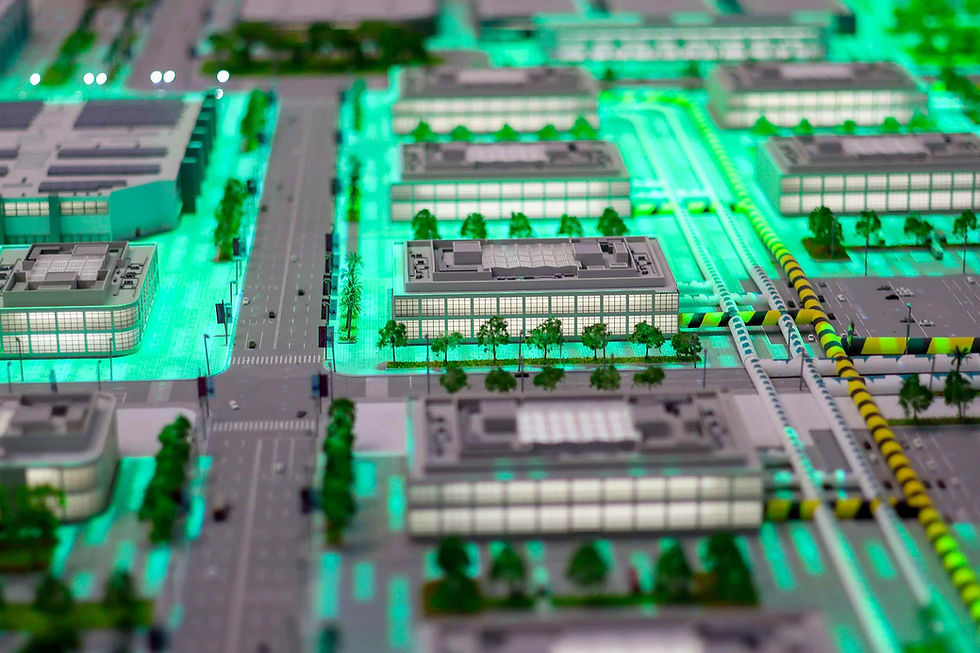
Among the most structurally important advances of the past decade, the digital twin deserves particular attention. It's a virtual replica of a city or district, continuously fed by real data, sensors, satellite imagery, and mobility flows, where planners can test scenarios before deploying them in the physical world.
Building a new transit line? Simulate its effect on pedestrian flow at rush hour first. Preparing for a flood? Model how every street behaves under different rainfall scenarios. Redeveloping a neighborhood? Study the effect on urban heat before the first shovel goes into the ground.
Singapore opened the field in 2014 with Virtual Singapore, a digital twin covering the entire island, which continues to inform projects such as citywide cooling and decarbonization strategies developed with ETH Zurich. In Europe, Helsinki's Helsinki 3D+ program has built a citywide digital twin used to analyze solar-power potential, run flood assessments, and perform noise modeling, with its Kalasatama district serving as a live testbed since 2018.*
Several U.S. cities, including Las Vegas and Orlando, have since built smaller-scale district-level digital twins, while Sejong City in South Korea has used the technology specifically to optimize waste-collection routing.
Paired with machine learning, this model becomes an urban laboratory capable of dramatically cutting planning errors, errors that cost fortunes once poured into concrete and asphalt. As Dr. Anu Kuncheria, a machine-learning engineer and former UC Berkeley transportation researcher, put it in a 2025 interview: digital twins and AI can model complex scenarios and surface recommendations, but the final call still belongs to human stakeholders, not the algorithm, a distinction that matters as much for how transfer learning lets these models generalize across cities as it does for who ultimately governs them.
What the Smart City Narrative Leaves Out
The Energy Paradox
Training an AI model consumes enormous amounts of energy. Running thousands of urban algorithms in real time demands servers, connectivity, and data centers. That's a direct contradiction with the environmental ambitions smart-city promoters like to advertise. We've covered this in depth in our analysis of AI's global environmental cost, and the question is worth asking here, too: at what point do the efficiency gains stop outweighing the consumption of the systems producing them?
Surveillance and Privacy
This is the question that stings. The more sensors, cameras, and flow-analysis systems a city installs, the more data it collects on its residents. In Singapore or Dubai, that collection is extensive and loosely regulated. In Europe, GDPR and national data-protection authorities impose guardrails, but they don't always hold.
The stakes became global news during the 2024 Paris Olympics, when France authorized AI-powered aerial video surveillance to detect abandoned objects and crowd disturbances at Olympic venues.*
France's data-protection authority approved the system only after requiring that it be barred from re-identifying individuals through biometric matching or tracking people seated continuously, a real-world illustration of regulators drawing lines around what AI-powered public surveillance is and isn't allowed to do. It's the kind of scrutiny that doesn't yet exist everywhere smart-city cameras are being installed.
Francesca Bria, the former chief technology officer of Barcelona and a leading voice on digital sovereignty, captured the underlying issue at the 2018 AI for Good Global Summit: building public trust in AI has to start with citizens, and cities need to earn that trust by working with residents rather than around them.*
The Digital Divide: Who Actually Benefits?
This may be the most underestimated risk. If smart infrastructure mainly benefits well-equipped neighborhoods, already-connected residents, and downtown tech clusters, it risks widening existing inequality rather than closing it. The digital divide doesn't stop at smartphone ownership, it also shapes how urban policy gets designed, for whom, and with whose input.
Public skepticism reinforces the point. A global study by the University of Queensland and KPMG, surveying 17,000 people across 17 countries, found that only 46 percent of people worldwide are willing to trust AI systems. That's a figure any elected official should sit with before rolling out an algorithmic optimization system without serious public consultation.*
What's Actually Coming by 2030
The next few years will likely bring three major shifts:
Digital twins are scaling up nationally. What began as single-city pilots in Singapore and Helsinki is expanding toward regional and state-scale deployment, with national geospatial and planning agencies across Europe and North America working to make the technology accessible to smaller municipalities, not just major metros.
AI folding into climate planning. Facing heat waves, flash floods, and droughts, cities will need algorithms capable of modeling climate scenarios at the neighborhood level. Copenhagen and Amsterdam are already doing this.
The governance question. This is the blind spot in every current smart-city strategy. Who decides how the algorithms work? Who audits their bias? Who gets access to the data? These aren't technical questions; they're political ones. They'll need real answers in the years ahead if smart cities are going to stay collective projects rather than products sold by private vendors to public authorities. For a longer view on where this could head, see our deep dive into what AI's trajectory by 2040 means for how we live.
The ideal smart city isn't the most connected one. It's the one where technology serves a clear vision for society, and where residents actually get a say in how their city is run.

FAQ
What is a smart city?
A smart city is an urban area that uses digital technologies, IoT sensors, artificial intelligence, and communication networks to optimize services like transportation, energy, waste, and water, improving residents' quality of life while reducing environmental impact.
Which cities are the most advanced smart cities in the world?
Singapore is routinely cited as the most advanced, thanks to its Smart Nation initiative launched in 2014. Barcelona, Copenhagen, Amsterdam, Tokyo, and Dubai are also frequently named as pioneers. In the U.S., cities like Las Vegas and Orlando stand out for their digital-twin pilots, while Dijon, France, offers one of Europe's most complete urban-supervision platforms.
How does AI improve traffic management in cities?
Algorithms analyze real-time vehicle flow and adjust traffic-signal timing to actual demand rather than fixed schedules. Singapore's sensor-driven approach has contributed to measurable congestion reductions, and similar systems help anticipate incidents and reroute drivers before delays cascade.
What is a city's digital twin?
It's a virtual replica of a city or district, continuously fed by real-world data from sensors, satellites, and mobility feeds. It lets planners simulate development scenarios, test transportation policy, or model crises like floods and heat waves before deploying anything in the real world.
Do smart cities respect citizens' privacy?
It's one of the central tensions. In Europe, GDPR and national data-protection authorities regulate how urban data gets collected, and regulators have imposed real limits, as seen with the restrictions placed on AI surveillance during the 2024 Paris Olympics. But the risk of drifting toward mass surveillance is real, especially where data governance isn't transparent or democratically accountable.
What's the difference between a connected city and a smart city?
A connected city simply has digital infrastructure, public Wi-Fi, sensors, and networks. A smart city goes further: it analyzes the data those systems collect to make decisions or optimize services in real time. The intelligence lies specifically in how the data gets processed, not merely in its collection.
Can small towns become smart cities?
Yes, if ambition is matched to available resources. Modular solutions exist: smart streetlight management, optimized waste collection, and citizen-reporting platforms. Federal and state infrastructure grants, along with public-private partnership models, increasingly help mid-sized municipalities fund pilot projects without the scale of investment a Dijon or a Barcelona requires.


Comments