
AI and Transhumanism: How Artificial Intelligence Is Redefining the Limits of Human Potential

The combined rise of artificial intelligence and emerging technologies like robotics raises fundamental questions about humanity's future and our place within it. This brings us to a subject that has long captivated science fiction, and is now firmly rooted in reality: transhumanism. The arrival of AI in everyday life is increasingly intertwined with emerging technologies such as neural implants, raising ethical, philosophical, social, and technical questions that demand serious attention. Could AI, when embedded in technologies that directly alter the human body, redefine what it means to be human?

In short
Transhumanism aims to transcend human biological limits through technology, especially AI, enhancing physical, cognitive, and psychological capabilities.
AI plays a central role in projects like Neuralink (neural implants) and bionic prosthetics, interpreting brain signals to drive real-world actions.
Near-horizon innovations include memory-boosting implants and human-machine interfaces with native internet connectivity.
Major ethical stakes include: human identity, bodily autonomy, hacking risks, and AI's potential influence over human thought.
The future may produce augmented humans, forcing society to confront an increasingly blurred boundary between person and machine.
First, What Is Transhumanism?
The Origins of the Transhumanist Movement and Its Core Mission
Transhumanism is a school of thought that emerged in the 20th century, primarily in the United States. It advocates using technology to surpass the human condition and overcome the biological limits inherent to our species. The movement's goal is to enhance physical, cognitive, and psychological capabilities through technological intervention, to make humanity more capable, more resilient, and ultimately more durable.*
It is worth clarifying that transhumanism specifically targets improvement through invasive procedures that directly modify the organism. Most definitions frame it as a movement that advocates the use of science and technology to enhance the physical, intellectual, and mental capacities of human beings, potentially extending to radical life extension or immortality. This distinction matters: external devices like AI-enhanced AR glasses would not typically qualify as transhumanist technology.
The Origin of the Word "Transhumanism"
The term is generally attributed to Julian Huxley, a British biologist and evolutionary theorist. It is easy, though incorrect, to conflate him with his brother Aldous Huxley, author of Brave New World, a novel whose themes feel extraordinarily prescient given the subject at hand. Julian Huxley first used the term in 1951, during a lecture titled "Knowledge, Morality, and Destiny."
What Is the Connection Between Artificial Intelligence and Transhumanism?
The link between AI and transhumanism is intuitive. Since the emergence of artificial intelligence, the technology has been positioned as a primary driver of human progress, promising enhanced workflows, longer healthy lives, and expanded cognitive capacity. Transhumanism, by its very nature, seeks to improve the human condition. The two fields were always destined to converge.
In fact, the connection predates the current AI boom by decades. In 1960, Marvin Minsky, American cognitive scientist and a founding father of artificial intelligence, published "Steps Toward Artificial Intelligence," in which he already explored AI as a mechanism for expanding human capabilities.
Beyond that historical anchor, AI's core competency, processing and interpreting massive volumes of data across modalities, makes it a natural engine for transhumanist applications: restoring sight to the blind by interpreting camera feeds, enabling paralyzed individuals to operate computers through decoded brain signals, and beyond.
Does AI Already Power Transhumanist Technologies?
No reliable, widely deployed technology currently exists that could be definitively classified as transhumanist and AI-powered. However, several experimental devices offer a compelling preview of what tomorrow's augmented human might look like.
Neuralink and the Augmented Brain: Elon Musk's Bet
In 2023, the U.S. Food and Drug Administration (FDA) approved human clinical trials for the neural implant developed by Elon Musk's company, Neuralink. The chip's mission: to build a brain-computer interface (BCI) that allows users to control electronic devices through thought alone. Behind what sounds like science fiction lies a genuine medical promise, offering greater autonomy and independence to the millions of people worldwide who are paralyzed or unable to use conventional devices.
Picture a fully digital future where anyone, including people with any form of disability, could open doors, order groceries, or stream content, without touching a single peripheral, because the interface lives inside the mind.
On AI's specific role: Musk has argued publicly that Neuralink could help humans avoid being outpaced by AI systems. By augmenting our cognitive capacity with a chip, we could ensure we are not left behind, or supplanted, as AI grows more powerful.*
Beyond the competitive dimension, Neuralink also promises to streamline human-AI interaction, making it faster and more intuitive. The implant itself would rely on AI to process incoming data, specifically to interpret brain signals more accurately and translate them into concrete actions in the physical or digital world.
Bionic Prosthetics and AI: Restoring, and Surpassing, Human Mobility
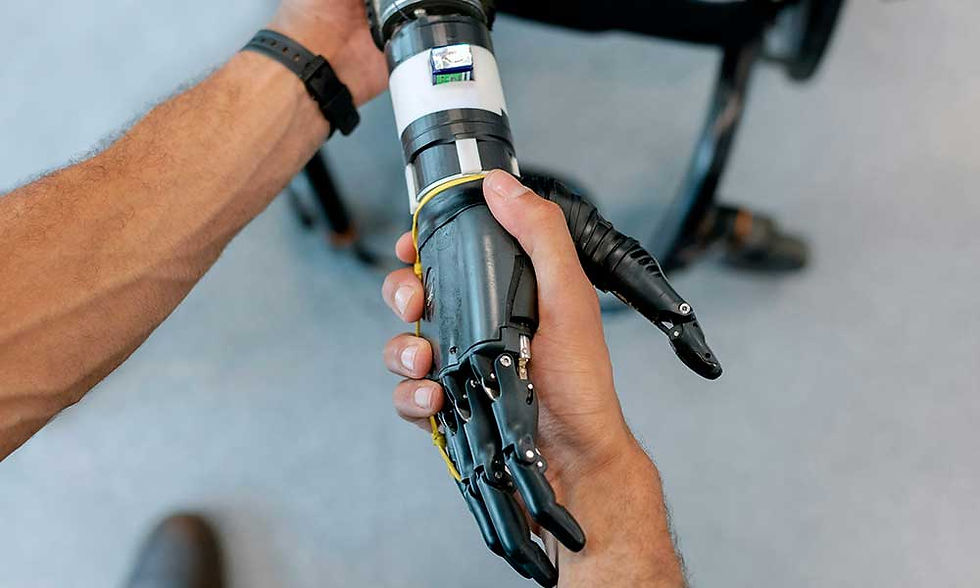
Another compelling application of AI in human augmentation: prosthetics. While the primary goal here is to restore capabilities lost to disability, bionic prosthetics hold the potential to exceed natural human performance. Their mechanical nature makes it easy to project a future in which these devices become powerful enough to produce genuinely augmented humans, raising the provocative possibility that some individuals might elect to replace healthy limbs with artificial alternatives for performance gains. The ethical questions that would follow are profound.
One leading example is Open Bionics, a UK-based company specializing in bionic prosthetics for amputees. In their devices, AI enables more accurate real-time interpretation of neural signals, allowing the prosthetic to move with greater fluidity and responsiveness.
What Near-Term Transhumanist Innovations Could AI Enable?
Augmented Soldiers
Military applications of AI come as no surprise. In a near-future scenario, armed forces could equip soldiers with neural implants similar to Neuralink to enhance cognitive performance in the field, enabling faster reaction times, sharper situational awareness, and better decision-making under pressure. Visual implants could overlay real-time tactical data directly in a soldier's field of view, or enhance visual acuity for long-range identification.
A Democratized Human-Machine Interface for the General Public
If we extend Neuralink's vision of a brain-computer interface to its logical conclusion, we can envision a radically reimagined relationship between humans and the digital world. What if our vision were natively connected to the internet? What if turn-by-turn navigation appeared as 3D arrows overlaid directly in our line of sight, no phone, no screen, no gesture required? What if our brains could interface seamlessly with computers, smart home systems, or autonomous vehicles?
Enhanced Cognitive Capabilities
What if you could upgrade your memory to accelerate learning? That is precisely the promise behind research conducted at the University of Southern California. As reported by Wired, a brain implant designed to boost memory yielded measurable results: both short-term memory and working memory performance increased significantly in test subjects.*
Beyond memory, one can envision implants that accelerate cognitive processing, recover lost memories, or assist patients with neurological conditions such as Alzheimer's disease.
What Might the Distant Future Look Like?
The Human-Machine Hybrid
Science fiction has long explored scenarios in which a human merges with a machine, becoming a functional cyborg capable of superhuman performance, on-demand internet access, or permanent physiological optimization. In this scenario, AI would serve as the processing engine at the core of such a hybrid system, managing and interpreting a continuous stream of biological and digital signals. The concept sits at the far end of the transhumanist spectrum, but the technological trajectory currently underway makes it less implausible than it once appeared.
What Are the Ethical Challenges and Limits of AI and Transhumanism?
The Ethical Problems of AI and Transhumanism
Transhumanism, with or without AI, raises profound moral questions. It entails direct bodily modification and fundamentally alters humanity's relationship with itself. As AI systems grow increasingly sophisticated, they may reach a level of complexity so advanced that implanting one inside a human brain becomes genuinely problematic, not merely technically, but philosophically and legally.
The question of consent, reversibility, and long-term identity must be addressed before these technologies scale. Who owns the data generated by a neural implant? Who is liable when an AI-embedded device malfunctions or is compromised?
The Dangers of AI and Transhumanism
Could connecting an AI to your brain mean surrendering control of your own body? This is not a theoretical concern, it is the central risk of a future in which neural implants powered by superintelligent AI systems can both assist and access the human mind. The question of bodily autonomy is urgent, not abstract.
Equally concerning is the threat of hacking or malicious exploitation of these devices. A compromised neural implant is not a stolen password, it is a breached mind. AI raises a further, deeper question: the boundary between human and machine, and by extension, the nature of human identity itself. With artificial intelligence embedded in our cognition, can we still claim our thoughts as authentically our own? How far should we allow AI to shape our decisions, and where must the line be drawn?
FAQ
Will transhumanism make humans "obsolete"?
Transhumanism aims to enhance humans through technology, not replace them. But the question carries real weight: if our cognitive and physical capabilities are radically augmented by implants and AI interfaces, does a meaningful distinction between human and machine still exist? The answer depends less on the technology than on the ethical frameworks society builds around it.
Are neural implants like Neuralink a breakthrough or a threat?
Both, potentially. Neural implants could transform outcomes for paralyzed patients or those with neurological diseases, but they carry serious risks: hacking, loss of autonomy, and technological dependency. The stakes are simultaneously medical, legal, and existential.
Could AI directly influence our thoughts?
With brain-computer interfaces, AI moves beyond passively interpreting neural signals. In theory, it could one day modulate or redirect them. This raises fundamental questions about cognitive liberty, free will, and human identity that no existing regulatory framework has yet adequately addressed.
Is transhumanism only for the wealthy?
Technologies like bionic prosthetics and neural implants are currently expensive and inaccessible to most people. If they become mainstream, the risk of a two-tier society emerges, those who can afford to "upgrade" and those who cannot. This is a social equity challenge that demands policy attention now, not after the fact.
What ethical limits should be established today?
Before these technologies scale, society needs enforceable rules: protecting the privacy of thought, preventing the commodification of the human body, and ensuring that innovation serves human dignity rather than reducing individuals to optimizable systems. The time to define those limits is before the technology outpaces the policy conversation.


Comments