
Will AI Colonize Mars Before We Do? What Space Engineers Are Really Building

Artificial intelligence is already on Mars. Not as a passenger, but as the pilot. And that's just the opening move in a much bigger redefinition of what "colonizing space" actually means. Landing humans on Mars is one problem. Keeping them alive once they're there is a different one entirely. Between the 20-minute average radio lag with Earth, the absence of an onboard doctor, average temperatures around -60°C, and an atmosphere that's 95% CO₂, the red planet imposes constraints no human crew can absorb alone. That's exactly why artificial intelligence has stopped being a side feature of space colonization projects: it's become the precondition for them.
Since December 2025, NASA's Perseverance rover has been crossing Jezero Crater along routes planned entirely by AI, without direct human routing. That's not a footnote. It's a signal that space agencies have shifted from Earth-controlled exploration to onboard autonomy as the operating model. Colonization won't happen with heroic astronauts and joysticks in Houston. It will happen with intelligent systems capable of deciding, building, healing, and managing, often alone, and often fast.

In Short
December 2025: For the first time, Perseverance completed two Martian drives, roughly 456 meters (1,496 feet) total, planned entirely by AI (Anthropic's Claude models), with no human-drawn route.
AI as ship's doctor: NASA and Google are developing CMO-DA, an AI medical assistant able to help diagnose and guide treatment autonomously, built for missions where communication lag rules out real-time consultation with Earth.
Building before arrival: Autonomous, AI-piloted robots are expected to assemble Martian, and likely lunar, habitats from local regolith, years before any human sets foot there.
Managing survival: Food, energy, air and water recycling, fault detection, everything that keeps a human alive on Mars will need AI systems capable of acting without waiting for a reply from Earth.
A stalled timeline: SpaceX had planned five uncrewed Starships toward Mars in the 2026 launch window. In February 2026, the company told investors it was prioritizing an uncrewed Moon landing instead, pushing serious Mars flights out to the early 2030s.
Twenty Minutes of Silence: Why Mars Can't Function Without AI
There's a detail that big Mars-colonization announcements tend to gloss over: the communication lag. Between Earth and Mars, depending on where the two planets sit in their orbits, a one-way radio signal takes roughly 3 to 22 minutes to arrive.
For a full exchange, message and reply, that means waiting up to about 44 minutes. In standard robotic exploration, that's manageable: you plan sequences in advance and wait for the reports. But in a crewed colonization context, where an urgent medical decision, a life-support failure, or an unexpected obstacle in a rover's path demands an immediate response, that lag becomes incompatible with human survival.
That's the founding argument behind the entire AI architecture being built around future Mars missions: the systems can no longer wait for a human. They have to decide.
The communication lag reaches roughly 20 minutes on average with Mars, and stretches to several hours with Jupiter's moons. Intelligent robots will need to prepare the ground before any crewed mission to the Moon or Mars.
This isn't a science-fiction hypothesis. It's the physical constraint that has been shaping space-autonomy programs for years. And it's worth remembering that AI isn't arriving in spaceflight as a novelty. If you want to understand how it was gradually built into exploration missions before becoming their backbone, our article on AI's role in space exploration gives that essential historical framing.
December 2025: The Turning Point Nobody Quite Saw Coming
On December 8 and 10, 2025, Perseverance drove a combined 456 meters (1,496 feet) along the rim of Jezero Crater, following a route it had not received from Earth. The route was generated by AI, specifically by Anthropic's Claude models, working from Mars Reconnaissance Orbiter imagery and digital elevation data. The system identified hazardous terrain (boulder fields, steep slopes, unstable sand) and mapped a route made up of a continuous sequence of waypoints.
For the first time in the history of space exploration, a rover crossed the surface of another planet following a route designed entirely by artificial intelligence.
What this actually changes: before this demonstration, JPL (Jet Propulsion Laboratory) engineers spent hours manually analyzing imagery and defining "waypoints", the checkpoints a rover can safely pass through. NASA estimates the AI approach cuts route-planning time roughly in half. Every AI-generated route is still validated by JPL engineers before transmission to Mars, human oversight hasn't disappeared, but its nature has changed.
Matt Wallace, manager of JPL's Exploration Systems Office, framed the stakes in a statement worth quoting directly:
“Imagine intelligent systems not only on the ground at Earth, but also in edge applications in our rovers, helicopters, drones, and other surface elements trained with the collective wisdom of our NASA engineers, scientists, and astronauts,” [...] “That is the game-changing technology we need to establish the infrastructure and systems required for a permanent human presence on the Moon and take the U.S. to Mars and beyond.”
NASA Administrator Jared Isaacman added that the demonstration shows how far the agency's capabilities have advanced, and that autonomous technologies like this help missions operate more efficiently as distance from Earth grows.
Perseverance's AI also relies on advanced algorithms to carry out complex tasks without direct human assistance beyond navigation on the red planet.
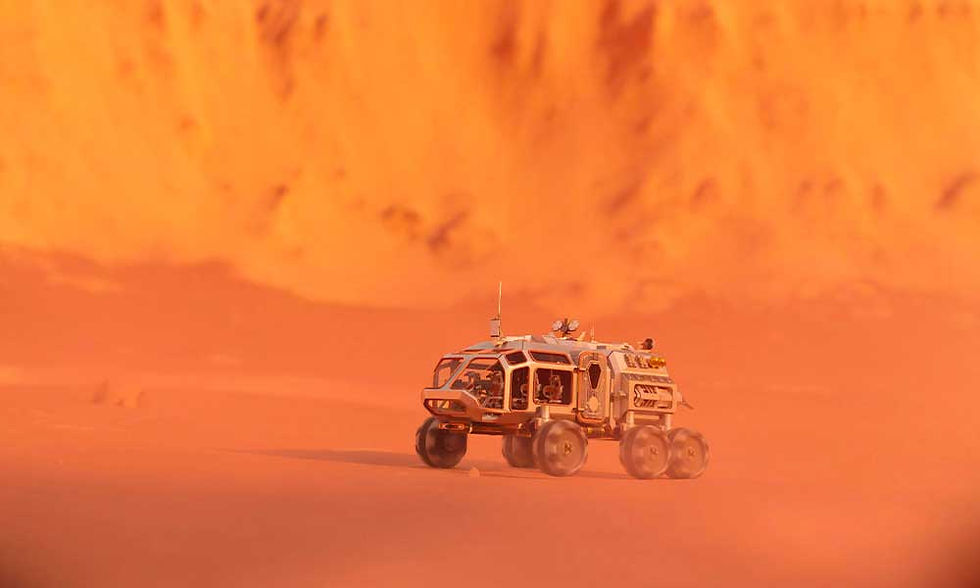
Building Before Arrival: AI's Invisible Construction Site
The basic idea is simple, but staggering: by the time the first humans set foot on Mars, something needs to already be waiting for them. Shelters able to withstand near-zero atmospheric pressure, cosmic radiation, and dust storms. Nobody can build that on arrival, not quickly, anyway. So robots need to go ahead of the crew: robots capable of building autonomously, using materials available on-site.
That's the focus of NASA's MMPACT program (Moon to Mars Planetary Autonomous Construction Technology). The effort centers on using regolith, the granular surface material found on planetary bodies, as the primary construction aggregate for infrastructure on the Moon and Mars. Current trials involve melting regolith with high-powered lasers or binding agents to produce radiation shielding, roads, and landing pads. For now, most of this work targets the Moon first, which functions as the logical next step in human spaceflight: a lunar base would serve as a staging post for launching missions to Mars more easily.
ICON, a 3D-printing construction company, is working with NASA on a system called Olympus, designed to use lunar and Martian regolith as raw building material. The company has already delivered a 1,700-square-foot simulated Mars habitat, Mars Dune Alpha, to NASA's Johnson Space Center, used since 2023 for isolation-living experiments that replicate the conditions of a long-duration mission.
Robots called Zebro Swarm have been explored to help conceptualize digging underground living spaces on the red planet, using additive manufacturing principles to reinforce walls with local materials. The autonomous robots would work like ants building a colony, communicating with each other and dividing tasks while digging underground.
ESA, for its part, has spent several years exploring the use of lunar regolith to 3D-print habitable structures. Foster + Partners designed a load-bearing "catenary" dome shell with a cellular wall structure to protect against micrometeorites and cosmic radiation, housing an inflatable structure inside that serves as the astronauts' living quarters.
What connects all these projects? Artificial intelligence isn't the construction tool, it's the site foreman. It coordinates the robotic arms, adjusts printing parameters for temperature swings, and flags structural defects in real time. On Mars, the architect will be an algorithm.
There's No Ship's Doctor, AI Is Taking Over
This might be the most critical use case, and the least visually dramatic. A crewed Mars mission involves 7 to 9 months of transit each way, plus a stay of several months before the return window opens. Throughout that entire stretch, astronauts are hundreds of millions of kilometers from the nearest available physician. The ISS can, in a real emergency, evacuate a patient. Mars can't.
NASA and Google addressed this by jointly developing CMO-DA (Crew Medical Officer Digital Assistant), an AI medical assistant trained on space-medicine literature. Built as a clinical decision-support system, it's designed to help astronauts diagnose and treat symptoms in real time when no doctor is reachable and communication with Earth is delayed or unavailable. In evaluation scenarios covering an ankle injury, flank pain, and ear pain, physicians, including a former astronaut, assessed the assistant's performance on initial evaluation, history-taking, clinical reasoning, and treatment planning. The tool is also meant to support flight surgeons on the ground with predictive data and analysis to guide their decisions.
The French Academy of Medicine, at a joint session with the French space agency CNES in May 2025, was blunt about the stakes: for missions farther out (Moon, Mars), the communication lag makes onboard AI essential for guiding diagnoses and technical procedures. The Academy specifically cited the MITBO interventional-radiology kit, designed so that non-physician astronauts can perform simple procedures, drainage, punctures, autonomously, with AI-supported guidance.
The Canadian Space Agency, meanwhile, funded ADAMS (ADvanced Astronaut Medical Support), an AI application field-tested in March 2025 in Quebec's northernmost Cree community, Whapmagoostui, in -32°C conditions far from any medical infrastructure. Developed by PARATUS Medical, ADAMS is an AI-powered app built to support astronauts through medical emergencies in deep space, validated here through real-world scenarios like a nurse working through an unfamiliar emergency procedure, and a hunter applying a tourniquet alone during a communications blackout.
Autonomous space medicine isn't a concept, it's an active program, with teams, budgets, and field trials. What these tools foreshadow is an unprecedented kind of human-machine relationship: not a passive tool, but a partner that knows what to do when you don't.

Resources, Energy, Food: AI as Survival Manager
Living on Mars is, first and foremost, an extreme logistics problem. Air, water, food, energy, nothing arrives ready to use. Everything has to be produced, recycled, optimized. And in an environment where every gram counts and an undetected failure can be fatal, human oversight alone isn't enough.
AI systems are transforming resource extraction, using advanced algorithms and robotics to locate, extract, and process vital materials more efficiently than ever. These digital supervisors use machine learning to analyze geological data and predict where essential resources, water, minerals, rare elements, sit beneath extraterrestrial terrain.
The complex task of allocating resources within a colony will also fall to AI, ensuring every gram of material is used where it's needed most.
Perseverance's PIXL instrument already demonstrates this logic in action. Using a technique called "adaptive sampling," the rover autonomously positions PIXL near rock targets, scans them, and selects the most promising minerals for deeper analysis, the first documented case of a spacecraft making autonomous decisions from real-time compositional analysis on another planet's surface.
That's a logic that will extend tomorrow across an entire colony's metabolism: detecting subsurface water, managing atmospheric recycling cycles, optimizing energy production, scheduling crop rotations in hydroponic greenhouses. AI won't just be a tool, it will likely be the load-bearing structure of the colony itself.
Beyond Mars: What Agencies Are Quietly Preparing
Mars gets most of the media attention, alongside the Moon. But the major space agencies are planning much further out.
Jupiter's moons (Europa, Ganymede) and Saturn's (Titan, Enceladus) are drawing growing scientific interest, particularly for their astrobiological potential. Communication lag with Jupiter's moons stretches to several hours. At that distance, AI autonomy isn't a convenient option, it's the only physically possible one.
SpaceX, for its part, has been thinking on an even larger scale, for AI infrastructure, not just crewed exploration. On January 30, 2026, the company filed an application with the U.S. Federal Communications Commission (FCC) for authority to launch and operate up to one million satellites as part of a proposed "SpaceX Orbital Data Center" system, solar-powered, optically interlinked satellites designed to host AI compute in orbit.
But it's worth staying grounded, or rather, in the orbit of realistic probabilities. This is where the picture has shifted since the French original was written. SpaceX had planned to launch five uncrewed Starships toward Mars during the November–December 2026 transfer window, following a string of Starship test-flight failures throughout 2025. Then, on February 6, 2026, the Wall Street Journal reported that SpaceX had told investors it would prioritize an uncrewed Moon landing, targeted for March 2027, and attempt Mars "at a later time". Two days later, Musk confirmed the pivot publicly, saying SpaceX would "strive to build a Mars city" within five to seven years, effectively pushing serious Mars settlement efforts toward the early-to-mid 2030s. Mars colonization remains a horizon, not an active program, and, for now, the Moon has taken priority.
To weigh what these ambitions really mean philosophically, for humans, for how we relate to ourselves and to machines, the articles on AI and transhumanism and the technological singularity offer angles that purely technical coverage tends to sidestep.
What Nobody's Really Saying: The Limits and Blind Spots
AI-driven Mars colonization raises questions press releases don't ask. The first is simple: at what point does a machine's autonomy on another planet become uncontrollable? On Mars, validating a decision from Earth takes at least 40 minutes round-trip. If an AI survival system makes a wrong call, on interior atmosphere management, on a medical diagnosis, the consequences could be irreversible before a human even has the chance to react.
There's also the dependency question. A Mars colony fully dependent on AI systems is, by definition, only as resilient as those systems. A bug, a failed update, a cyberattack, even 225 million kilometers away, leaves the colony exposed.
The enthusiasm is real, and the progress is concrete. But colonizing space with AI also means exporting our algorithms' biases, vulnerabilities, and imperfections beyond Earth. And on Mars, nobody's coming to push the update. At least not quickly.
FAQ
What role does AI play in colonizing Mars?
AI plays a foundational, cross-cutting role: autonomous rover navigation, life-support management (air, water, energy), medical diagnostic support, construction-robot piloting, and geological resource analysis. It compensates for the roughly 3-to-22-minute one-way communication lag between Earth and Mars, which makes real-time teleoperation impossible.
Can AI already drive a rover on Mars?
Yes. In December 2025, NASA demonstrated that the Perseverance rover could cross the Martian surface following a route planned entirely by AI (Anthropic's Claude models), without human involvement. JPL engineers still validate the plans before transmission, but no longer draw the routes themselves.
When could the first humans go to Mars?
SpaceX had targeted a crewed mission around 2028–2029, with NASA projecting similar timelines. Repeated Starship test failures throughout 2025, followed by SpaceX's February 2026 decision to prioritize a Moon landing over Mars, have pushed the realistic timeline for crewed Mars flights toward the early-to-mid 2030s. Most independent experts consider even that estimate optimistic.
How could AI treat astronauts on Mars?
NASA and Google are developing CMO-DA (Crew Medical Officer Digital Assistant), an AI medical assistant trained on space-medicine literature, designed to guide astronauts through diagnosing and treating symptoms autonomously, without depending on a real-time link to Earth.
What is ISRU, and how does it relate to AI?
ISRU (In-Situ Resource Utilization) means using resources already present on-site to supply a colony, regolith for construction, ice for water and oxygen, local materials for 3D printing. AI sits at the center of this process: it analyzes geological data, locates resources, and pilots the extraction robots.
Can a habitat be built on Mars before humans arrive?
That's precisely the goal of programs like NASA's MMPACT and projects like ICON's Olympus. AI-piloted autonomous robots are expected to 3D-print structures from Martian regolith years before the first human colonists arrive.
What are AI's limits in space colonization?
The main limits are: system reliability in an extreme environment that's difficult to test at scale on Earth, the impossibility of real-time human correction if something goes wrong, the risks of total dependency on algorithmic systems for survival, and the potential biases inherited from how the underlying models were trained.


Comments